Every town hall in Friesland has one. Every official document. Every municipal flag flying over a canal or courthouse.
Coats of arms.
But these aren’t just pretty pictures. They’re a symbolic language that’s been speaking Frisian for over 700 years.
And once you know how to read them, you’ll never look at a Frisian building the same way again.
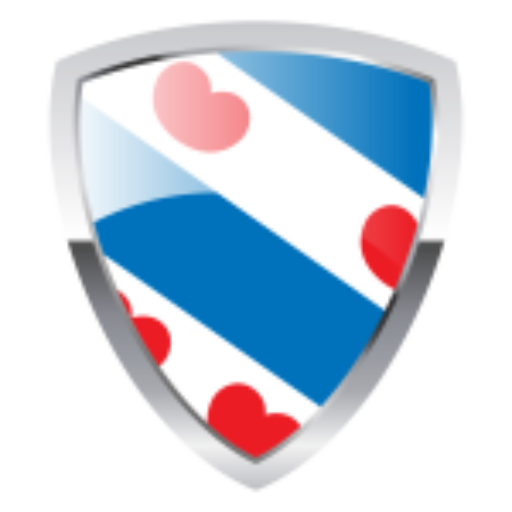
The most famous symbol is the pompeblêd. It looks like a heart, but it’s actually a water lily leaf. Seven of them appear on the Frisian flag in bold red against blue and white stripes.
Those seven leaves represent the seven traditional Frisian sea lands. Westergo. Oostergo. The islands. Each one a piece of the historical Frisian territory that fought the sea and won.
The pompeblêden show up everywhere in Frisian heraldry. Town arms. Family crests. Official seals. They’re basically the Frisian calling card.
Water lilies make perfect sense for a province that’s mostly water. The plant floats on the surface, roots in the mud below, blooms above the chaos. That’s Friesland in a nutshell.
Then there’s the Frisian lion. He shows up crowned, usually blue, often holding a sword or standing on his hind legs looking ready to fight somebody.
The lion appears in the coats of arms of multiple Frisian municipalities. Sometimes he’s alone. Sometimes he’s paired with other symbols like ships, anchors, or more pompeblêden.
Medieval Frisian noble families had their own elaborate coats of arms. The Dekema family. The Cammingha clan. The lords of various terpen and manor houses across the province.
These weren’t just decorative. They were legal identifiers. Your coat of arms appeared on official documents, seals, buildings, and basically anything that needed to say “this belongs to us.”
When families married, their arms combined. When estates were inherited, the symbols transferred. It was like a visual family tree that everyone could read at a glance.
Municipal heraldry in Friesland tells local stories. Hindeloopen’s coat of arms features a ship because they were master sailors. Bolsward has keys because of Saint Martin. Sneek has three lilies and a crown.
These arms often date back to the 13th or 14th century. They survived wars, occupations, and administrative reorganizations. When municipalities merged in recent decades, communities fought to keep their historic symbols alive.
The College of Arms in the Netherlands still regulates heraldry today. You can’t just make up a coat of arms. There are rules. Specific colors called tinctures. Specific positions and arrangements. A whole grammar of visual symbolism.
Frisian heraldry uses the standard heraldic tinctures. Or (gold). Argent (silver/white). Gules (red). Azure (blue). Sable (black). Vert (green).
But the symbols chosen are distinctly Frisian. Water imagery dominates. Ships and anchors. Waves and fish. The occasional eel.
Some towns use Frisian-specific imagery. The village of Jorwert has a coat of arms featuring a golden church on blue. Oosterwierum shows a ship and a tower. Each one is a miniature story of local identity.
The interesting part is how seriously Frisians still take this. These aren’t dusty medieval relics. They’re on modern buildings, websites, official letterhead, and sports club logos.
Town pride in Friesland often centers on these heraldic symbols. They appear on local merchandise, in pub decorations, on welcome signs at town borders.
During the Elfstedentocht ice skating race, people wave flags bearing their town’s arms. The symbols become rallying points for local identity.
Learning Frisian often means learning to recognize these symbols too. They’re part of the visual vocabulary of Frisian culture. See the pompeblêden, you know you’re in Frisian territory.
The heraldic tradition connects modern Friesland to its medieval past. These symbols have survived longer than most buildings, longer than political borders, longer than entire dynasties.
They’re still doing what they were designed to do eight centuries ago. Marking identity. Claiming space. Saying in pictures what takes paragraphs to explain.
This is Friesland. This is us. This symbol has been ours since before your country existed.
And that’s pretty cool for what started as fancy medieval branding.